Working with Diverse Facets of Interactive Media and Haptics
Introduction
The Applied Interactive Media (AIM) Lab is a research group that works across diverse facets of neurohaptics, cognitive haptic interaction, and brain-machine interfaces. Using electroencephalography (EEG) alongside machine learning and novel haptic devices, the lab investigates how the brain encodes touch, and how that understanding can inform the design of systems that sense, interpret, and deliver meaningful tactile experiences. Applications include biofeedback, neurorehabilitation, and medical training and education. The core research pillars are:
EEG-based Neurohaptics: Investigates the neural correlates of tactile and kinesthetic experiences, such as vibrotactile, electrotactile, thermal, and pressure modalities, using EEG signals, functional connectivity analysis, and deep learning classifiers trained on single-trial data. Applications are in neurorehabilitation and biofeedback.
Cognitive haptic interfaces: Develops haptic systems that adapt in real time to a user's cognitive state inferred from EEG, building neurophysiology-driven models of haptic experience that move beyond self-report to enable closed-loop, brain-machine interaction.
Affective Haptics: Explores how touch conveys and modulates emotion — spanning EEG-based emotion classification, haptic feedback for pain distraction, vibrotactile stimulation for emotional regulation, and mediated social touch in virtual and remote environments.
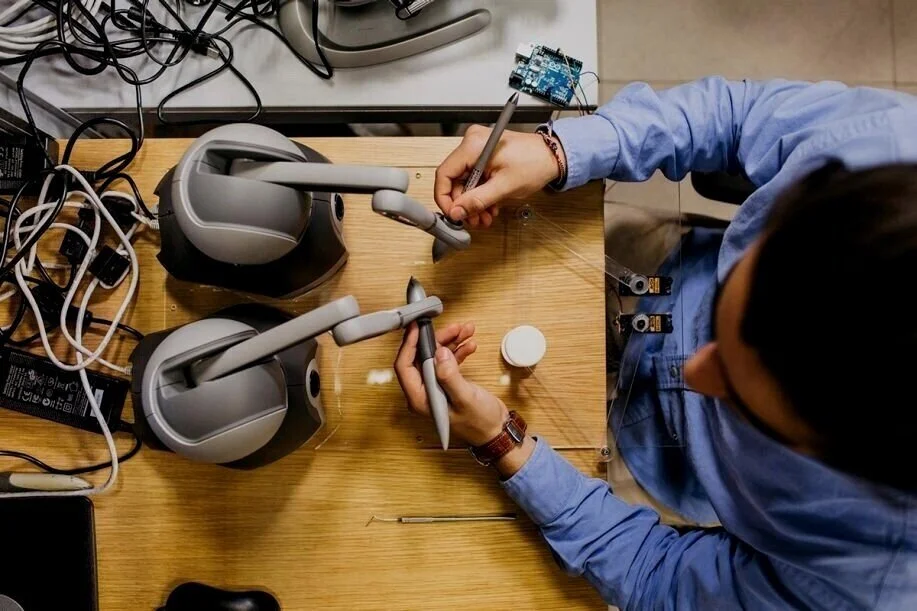
Haptic/XR Simulations for Training and Education: XR and haptic simulations for clinical skill acquisition, including Haptodont, a bi-manual periodontal probing simulator that renders tactile sensations, such as tissue resistance, texture, and stiffness, and a custom haptic syringe for VR-based local anesthesia training, developed in collaboration with NYU dental faculty.
Latest News
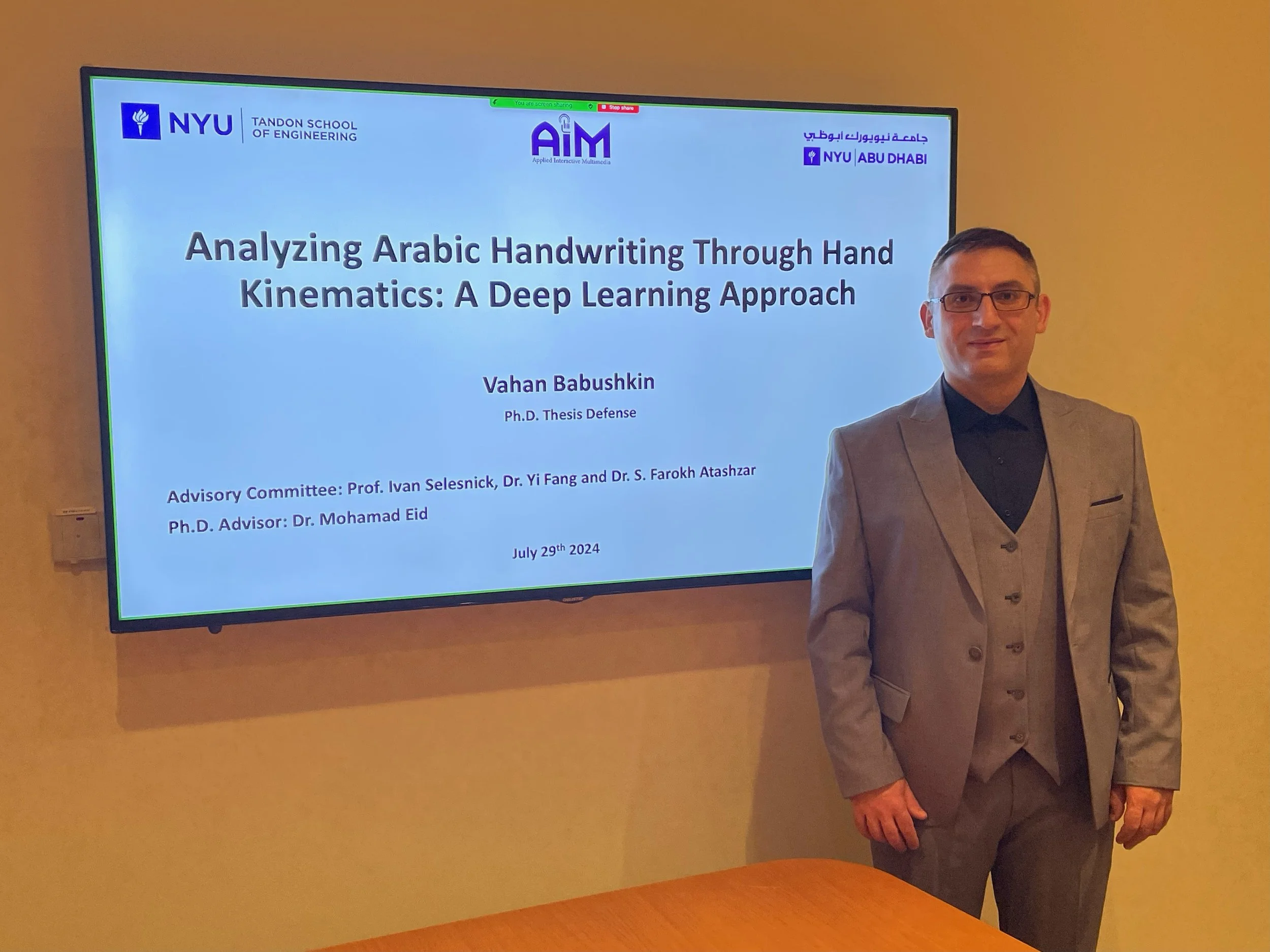
Ken iiyoshi successfully defended his PhD thesis at the New York University Tandon School of Engineering, NY entitled “Soft Actuator Design Workflow: An Origami and Nanoparticle-Polymer-based Untethered Meso-scale Applications”
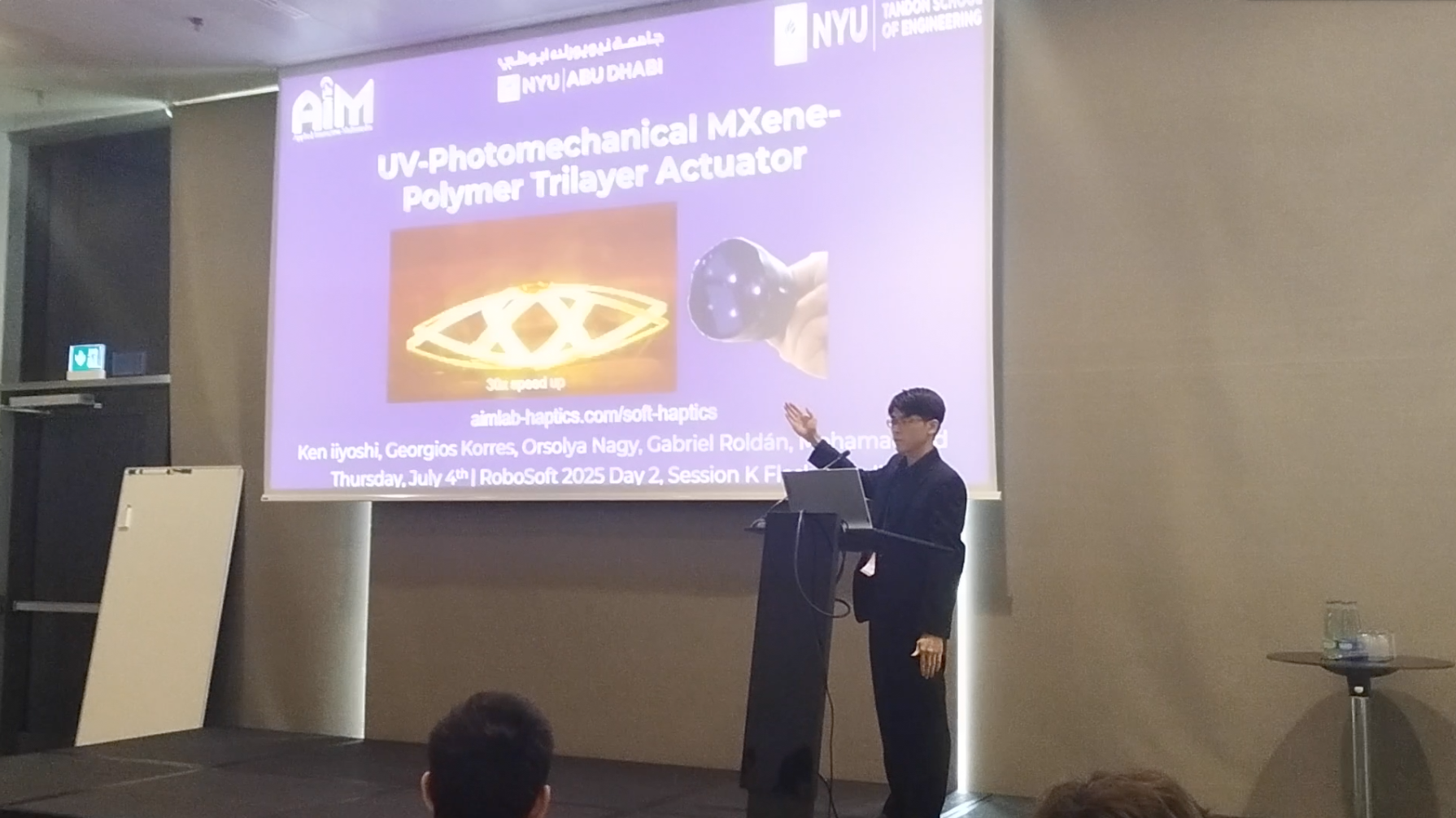
From April 23rd to 26th, the 8th IEEE-RAS International Conference on Soft Robotics (RoboSoft 2025) took place in École Polytechnique Fédérale de Lausanne (EPFL), Swizterland.
From July 1 to 5th, the International Conference on Manipulation, Automation and Robotics at Small Scales (MARSS 2024) took place in Technical University of Delft, Delft, Netherlands.
From July 7 to 10th, the IEEE Haptics Symposium 2024 took place in Long Beach, California.
Ken iiyoshi, a PhD Candidate in AIM Lab, received a global award from INPEX Scholarship Foundation, based in UAE, Japan, Australia, and Indonesia.
Congratulations to Ken iiyoshi for passing his PhD Qualification Exam!
Ken iiyoshi, Ruth Gebremedhin, and Mahrukh Tauseef have proposed a new real time haptic communication protocol that will be potentially based on the 5G Internet.
AIM Lab research project KATIB gets featured in The National.
2019 IEEE International Symposium on Haptic Audio-Visual Environments and Games (HAVE 2019)
4th Joint UAE Symposium on Social Robotics (JSSR2019), 3-6 February 2019
2018 IEEE International Symposium on Haptic Audio-Visual Environments and Games (HAVE 2018)
AIM Lab research gets featured in TES and The National
The First International Symposium on Intelligent Robots: Autonomy and Vision (IRAV), March 11-13, 2018
3rd Joint UAE Symposium on Social Robotics (JSSR2018), 4-7 February 2018
UN International Arabic Language Day symposium, Sharjah, UAE, December 18,2017
2017 IEEE International Symposium on Haptic Audio-Visual Environments and Games (HAVE 2017)
Featured Projects
Neurohaptics
Neural models that quantify human haptic experiences based on brain activities. Stimulates human haptic responses during haptic intervention.
KATIB
Development of haptically-guided assistive platform to help children with learning difficulties to acquire important handwriting skills in different languages.
Haptogram
Provides 3D tactile feedback via focused ultrasound without physical contact with human skin. Designed to create an immersive multimodal system.
Haptic Jacket
Studies the relationship between touch and emotions. Haptic jacket displays vibrotactile sensation with several modes and sensations of interaction.
Haptodont
Development of haptics-based virtual reality periodontal training simulation. Designed to provide both visual and tactile dental sensations.
Haptic Eye
Designed to produce thermal property measurements of materials based on their response to thermal excitation. Allows material identification.